resourcesArticlesFUNCTIONAL STRENGTH TRAINING FOR FOOTBALL Football players notably spend a large percentage of their time conditioning in the weight room. However, the force generated in the weight room does not always directly transfer to the playing field. For while many traditional weight training exercises such as the bench press increase absolute strength they do not obey the laws of training specificity and therefore do little for game related skills and attributes such as maintenance of core stabilization, sensitivity to manipulate your opponent's body weight and the ability to exert force when combined with correct footwork. Moreover, although strength levels may significantly increase in the weight room, if an athlete does not learn how to contract, and in particular relax efficiently, the increased strength acquired in the weight room may not directly translate to more powerful striking and manipulation of an opponent on the playing field.
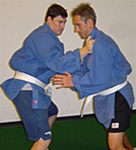
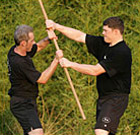
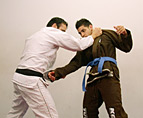
Functional training for sport is characterized by the use of multi-joint, multi-planar motions performed in functional weight bearing positions such as standing and stride standing. The exercises promote control over one's bodyweight, challenge balance and proprioception (awareness of body position), and activate key stabilizers around the spine, hips and shoulder girdle. Examples of functional strength exercises utilized by Martial Arts for Football include the use of judo uniforms or gis as they are referred to in Japanese as well as stick and partner resistance training.
Partner resistance drills are specifically derived from martial arts training and differ from manual resistance training in their dynamic practical application. Their use has the added advantage of improving your ability to "stick" and manipulate your opponent. Stick refers to the maintenance of physical contact between you and your opponent and is used by boxers who grab and nullify their opponent's arms when they are in being hit excessively or need a rest. All of the functional methods of strength training mentioned mimic the type of resistance encountered on the playing field and therefore provide a key link between the weight room and the playing field. The benefits of functional strength training for football can be summarized as follows: 1) They enhance functional strength that directly translates to the playing field and the ability to play
football 2) The drills improve sensitivity and ability to feel exactly where your opponent's weight distribution
lies — necessary to manipulate them and exploit their weaknesses
3) The drills are performed in weight bearing functional positions 4) Many of the drills mimic the type of game situations you will encounter on the playing
field 5) Importantly, the exercises can significantly improve absolute strength levels 6) The drills teach you how to contract and relax efficiently 7) Significantly improve your footwork 8) Significantly improve grip strength 9) Their use allows an economical use of your time 10) Finally, functional strength training for football gives you a valuable alternative to conventional strength raining that can provide variety and help relieve the monotony of the weight room For video footage of functional strength training drills outlined above, please visit the Videos page. |

|
|||||||||