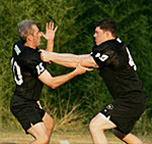
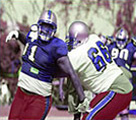
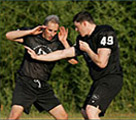
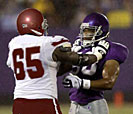
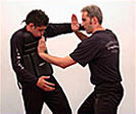
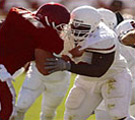
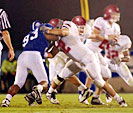
RESOURCESArticlesWHY USE MARTIAL ARTS TRAINING FOR FOOTBALL? When I first became involved in the game of football in 1997 I was immediately struck by the marked similarities between football and the martial arts. Football, particularly on the line of scrimmage, entails significant hand to hand combat. Martial artists have been developing, practicing and refining hand to hand combat techniques for thousands of years. The game of football has been played for just over a century. It therefore makes sense to draw upon the vast practical knowledge and expertise that has accumulated in the martial arts and apply it to the game of football.
Football players notably spend a large percentage of their time conditioning in the weight room and out on the playing field. However, comparatively little time is devoted to skill development, where athletes are taught to evade, block, strike and wrestle with their training partners in a controlled setting. Skill acquisition is probably the most valuable asset a football player can be taught. It gives smaller, weaker and less physically gifted athletes the ability to neutralize and overcome their opponents. Martial artists are experts at blocking and avoiding strikes. In football, one of the worst case scenarios for an offensive or defensive lineman is to be “pancaked,” thereby leading to a “sack” or a touchdown. If you can evade and block your opponent’s strikes then — a) your opponent will not be able to hit you and b) your opponent will be unable to get his hands in position in order to manipulate you.
However, in martial arts the stakes are much higher. A strike from an opponent could be a chop to the throat, a finger jab to the eyes or a stab to the abdomen with a knife. It is therefore no surprise that martial artists are experts at avoiding and blocking strikes — their lives may depend on it! If you can land your strikes with speed and power or quickly get your hands in position to use them, you will have a much better chance of manipulating your opponent. Martial artists are experts at striking with power, as witnessed by the skill of “Tameshiwari” or powerbreaking. Powerbreaking involves breaking a variety of materials including wooden boards, cement tiles, concrete slabs and bricks with various parts of the body. In addition to striking power, other martial arts and martial artists are particularly renowned for their speed.
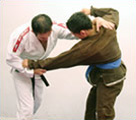
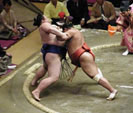
Bruce Lee was famous for his “non-telegraphic” punch, which was almost impossible to block. Master of Wing Chun Kung Fu and Martial Arts for Football team member James Sinclair has completed over 35 punches in just three seconds! One key skill necessary on the line of scrimmage is the ability to wrestle with an opponent in order to manipulate him in a desired direction. Judo players, Grapplers, Shoot and Sumo Wrestlers spend a large percentage of their time wrestling and grappling with their opponents. The goal in these martial arts is to manipulate an opponent’s body in order to take, or throw him to the ground. The high level of skill attained through wrestling and grappling in the close quarter (tied up) position can be directly transferred to the game of football. This skill is exemplified by blind judo players who, through the sensation of touch alone, can often compete on level terms with their sighted opponents.
Physically, martial arts are extremely challenging. Learning how to block, strike, grapple and evade opponents improves eye, hand and body coordination while also improving balance, footwork, and total body awareness. Martial arts training also improves speed and reaction times, sensitivity to an opponent’s motions, along with core and general body strength. Another important skill required by both defensive and offensive linemen is the ability to drive block and move opponents backwards. One of the primary aims of Sumo Wrestlers (that can be applied to the game of football) is to manipulate an opponent in order to push him backwards out of the ring. Some observers would say that Sumo Wrestlers and modern football linemen also share the same eating habits!
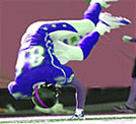
One other extremely important but under-emphasized skill in football is the ability to fall to the ground safely. This is known in martial arts as break-falling. Break-falling effectively serves two purposes. The first is injury prevention. There are numerous examples of players (particularly quarterbacks) who dislocate their fingers and shoulders because of poor breakfalling technique. Secondly, if performed correctly, breakfalling also allows you to get up more quickly to further contribute to a play. Aikido practitioners and judo players are particularly renowned for their ability to breakfall safely to the ground from various positions and heights. Aikido and Ju-Jitsu practitioners are also particularly renowned for their ability to use joint manipulation to control an opponent. Controlled joint manipulation is a skill that has considerable potential to be applied to the game of football.
Specific forms of martial arts training, such as the use of Judo gis (uniforms) to improve grappling skills, also enhance functional strength and provide an important link between the weight room and the playing field. Martial arts can be used to significantly improve general and football specific fitness, adding important variety to training and thereby helping to avoid physical and mental stagnation.
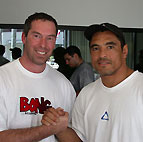
The Gracie family came to prominence with the advent of the “no-holds-barred,” Ultimate Fighting Championships (UFC) in 1993. The Gracies completely revolutionized the martial arts world with their Brazilian JuJitsu and skill in grappling. Rickson has been quoted as saying that when competing in front of 50,000 spectators in a no-holds-barred match his level of arousal rises only ten percent above that of a normal training session. Such a high level of control and belief in one’s ability fosters self-confidence and may explain why the vast majority of experienced martial artists display tremendous humility in their art. Learning to control your mind and body are key steps towards self-advancement both on the football field and in martial arts.
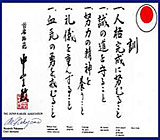
A student’s physical control is tested with the use of a pencil that is moved to various striking ranges. The aim is to punch with full speed and power to within a fraction of an inch of the pencil as it is moved by the examiner without striking it. If the student demonstrates a lack of control by punching and hitting the pencil or is too far away from the pencil the black belt is not awarded. The ability to aggressively control your body with such a high level of precision has obvious advantages for the game of football. Martial arts also teach focus, respect and humility. The ability to focus for the entire four quarters is a major prerequisite for the game of football. Focus in the martial arts is fostered through hours of training, often in a fatigued state, in which the mind is trained not to stray from the task at hand. Many martial arts such as Shotokan karate employ a code of conduct under which training is practiced.
Such foundational qualities can provide a valuable contribution to any football program, on or off the field. Training for martial arts and football should be conducted in an atmosphere of mutual respect between practitioners, as ultimately everyone is learning and trying to improve together. The respect and camaraderie fostered through training is one reason why Kung Fu practitioners refer to each other as Kung Fu “Brothers” and “Sisters.” There is no room for egos. A person whose overriding concern is his ego will only make limited progress. It is only by working together in training that the higher levels of attainment can be reached. Finally, the martial arts also teach discipline and perseverance. It takes tremendous discipline and perseverance to tolerate the physical and mental demands of training necessary to excel in the martial arts. As Vince Lombardi, the legendary coach of the Green Bay Packers noted, “Success in life is a matter not so much of talent or opportunity as it is concentration and perseverance.” The qualities of focus, respect, discipline, perseverance and self control can provide a significant contribution to any football program. For a summary of the benefits of martial arts training for football please click here. |

|